



Custom Aluminum Batten Screen Systems in 2026: Why Commercial Builders and Distributors Are Switching to Pre-Engineered Modular Facade Profiles
1. Market Context & Structural Data: Why Architectural Batten Screens Are Dominating 2026 Specifications
The global outdoor privacy screen and architectural batten facade market reached USD 3.16 billion in 2026 and is projected to surpass USD 5.78 billion by 2035, expanding at a 6.9% CAGR. Once treated as secondary decorative screening, pre-engineered aluminum batten systems have evolved into a primary envelope specification across commercial developments, multi-residential apartments, and high-end residential projects. This surge is driven by three decisive industry forces:
Stricter Combustibility Codes (NCC & NFPA Compliance): Recent updates to the Australian National Construction Code (NCC) and NFPA fire safety standards across North America and the UK have sharply restricted combustible cladding and traditional exterior timber battens on external facades. Certified 6063-T5 extruded aluminum systems now represent the mandated non-combustible standard.
Woodgrain Sublimation Replacing High-Maintenance Hardwood: While exterior timber costs have climbed over 34% over the past nine quarters, ongoing maintenance (staining, rot remediation, sealing) adds $180–$250 per square meter over a 10-year lifespan. Modern architectural woodgrain-finished aluminum battens provide the organic aesthetic warmth of natural timber alongside a 30+ year service life, zero termite risk, and near-zero maintenance.
Landed Cost Stability & Trade Defense: With anti-dumping duties on Chinese and Malaysian aluminum extrusions remaining active across Australia, the UK (up to 128.17%), and the United States, commercial developers can no longer risk landed cost volatility. Importers are securing duty-free supply lines from fully integrated Southeast Asian manufacturing hubs like Royal Metal's Rayong, Thailand facility.
"In 2026, facade contractor profitability is no longer won on the job site with field cutting and welding. It is decided by pre-engineered modularity: whether batten systems arrive pre-configured to span up to 4,000 mm heights, flat-packed to triple container utilization, and backed by verifiable non-dumped origin documentation that breezes through customs."
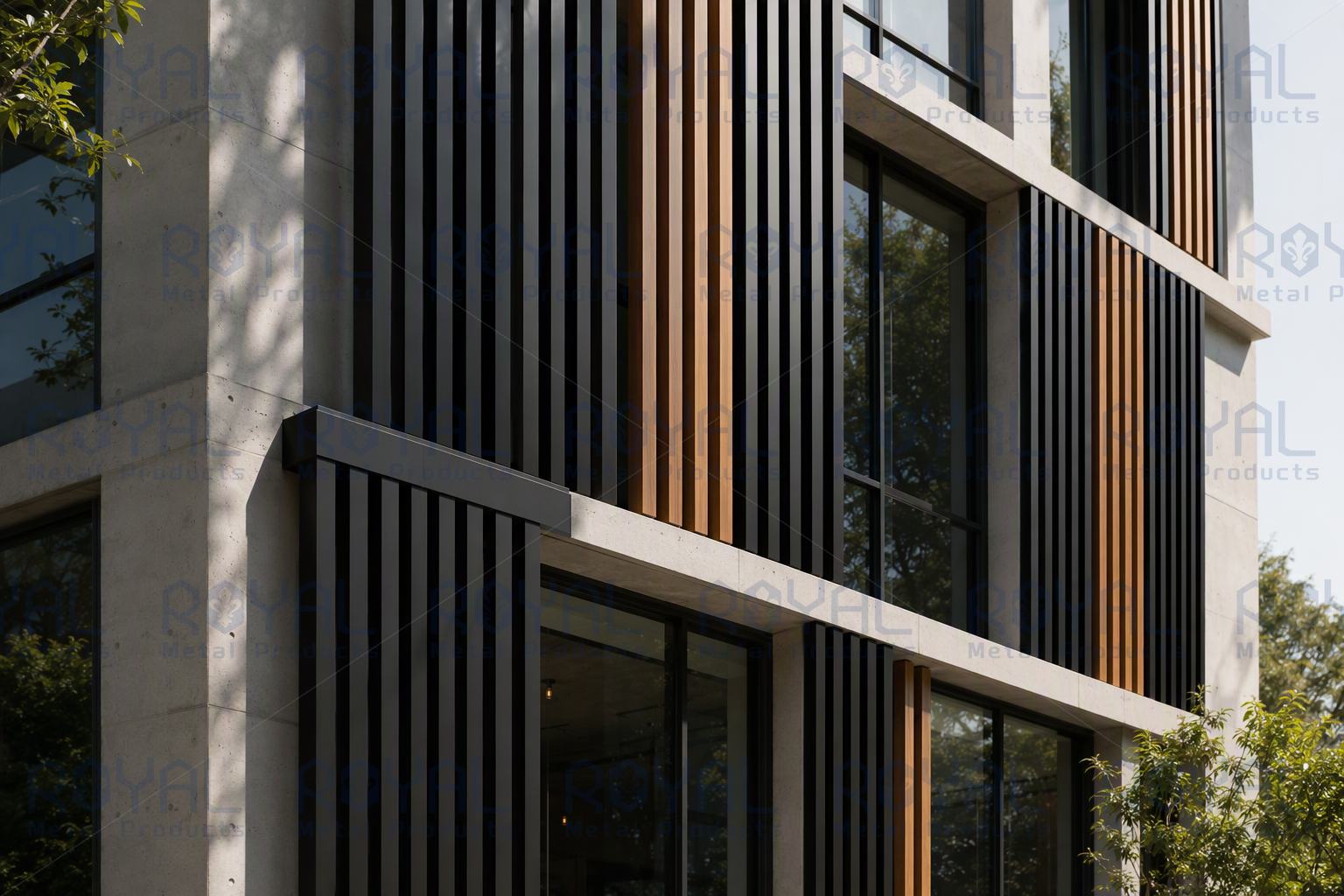
Figure 1: High-rise commercial facade featuring 50x100mm and 50x150mm vertical aluminum batten screens in satin black and architectural woodgrain finishes.
2. Specifier & Architect Expectations: The Four Engineering Benchmarks
Commercial facade engineers, architects, and Tier-1 builders have moved well beyond generic hollow tubes. Modern project tenders demand systems engineered around four specific structural criteria:
Engineered Spanning & Wind-Load Performance: For building elevations, balcony privacy screens, and plant room enclosures, battens must resist high deflection forces. Specifiers look for structured profile sections—including 30×50 mm, 50×50 mm, 50×100 mm, and 50×150 mm base series up to 200 mm custom sections—capable of standing up to 4,000 mm panel heights within a standard 50 kg panel weight limit.
Clean Concealed Fixings & Flexible Bracketing: Exposed fasteners degrade architectural elevation cleanlines. Specifications require modular bracket solutions—such as heavy-duty RL-230 intermediate aluminum brackets (2.5 kg/m) and inclined triangular brackets—that absorb structural movement while concealing anchor hardware.
C5 Coastal & High-UV Durability: In coastal corridors and marine environments (within 1–5 km of saltwater), standard industrial coatings chalk within 3 to 5 years. Specifiers enforce Qualicoat Class 2 or AAMA 2604/2605 specifications (60–80 μm) with rigorous chemical pre-treatment to guarantee 15- to 25-year gloss and color retention.
Acoustic & Airflow Balance: External batten screens must maintain a calculated 50%–70% visual privacy angle while ensuring uninterrupted natural cross-ventilation for mechanical HVAC screens and balcony enclosures.
3. Supply-Side Bottlenecks: Where Conventional Procurement Fails
Despite strong project pipelines, facade sub-contractors and distributors often suffer severe margin compression due to traditional supply chain friction:
"Shipping Air" Freight Waste: Sourcing fully pre-welded panels wastes vast shipping volume. A standard 40ft container of welded screens rarely exceeds 8 to 10 tons of payload, carrying only 700–900 m² of screening and multiplying ocean freight costs per square meter.
Labor Cost Explosions on Site: Delivering raw, un-notched extrusion lengths forces installation crews to manually measure, space, and drill every anchor point. At commercial installer rates of $70–$120/hour, site errors and alignment callbacks quickly wipe out job profit.
Finish Discrepancies Across Mixed Assemblies: When battens, mounting channels, and structural brackets are coated at separate third-party facilities, subtle batch variations (ΔE > 1.5) become glaringly obvious under direct exterior sunlight.
Anti-Dumping Duty (AD/CVD) Audit Vulnerability: Complex transshipment schemes lacking bona fide smelter-to-extrusion documentation expose importers to retrospective border duty clawbacks.
4. Best Practices of Forward-Looking Buyers: Engineered Modularity
To maximize margin and eliminate field labor, leading international distributors and facade contractors have adopted factory-pre-engineered modular systems:
| Procurement Metric | Traditional Site-Built Screening | Pre-Engineered System (Royal Metal Standard) |
|---|---|---|
| Profile Sizing Range | Limited standard tubes; custom dies require high tooling cost | Full 30, 50, 75, 100 mm series up to 200 mm custom sections (30x30 to 200x30 mm) |
| Installation Options | Rigid on-site welding or face screws; inflexible connection | Triple system: RL-230 bracket connection, 50x50/200x50mm keel system, or welded top/bottom plate |
| Container Fill Efficiency | 700–900 m² per 40ft container (welded frames) | 2,400–3,200 m² per 40ft container (modular knockdown bundles; 3.5x savings) |
| Installation Speed | 4–6 hours per standard bay with manual spacing | Under 45 minutes per bay using precision pre-punched spacing keels (≤520mm hole centers) |
| Trade & Duty Exposure | Subject to 10%–50%+ anti-dumping measures | 100% Thailand origin with full smelter audit trail; 0% AD/CVD landed cost |
Leading manufacturers like Royal Metal supply this exact level of integrated manufacturing. Our Custom Aluminum Batten Screen Systems are fully configurable around architect-specified batten dimensions, spacing intervals, and structural connections. Supporting building elevations, residential balconies, and modern privacy screens, the system incorporates dedicated RL-230 bracket profiles, square-tube keels, and welded base/head assemblies that anchor via φ10/φ12 expansion bolts.
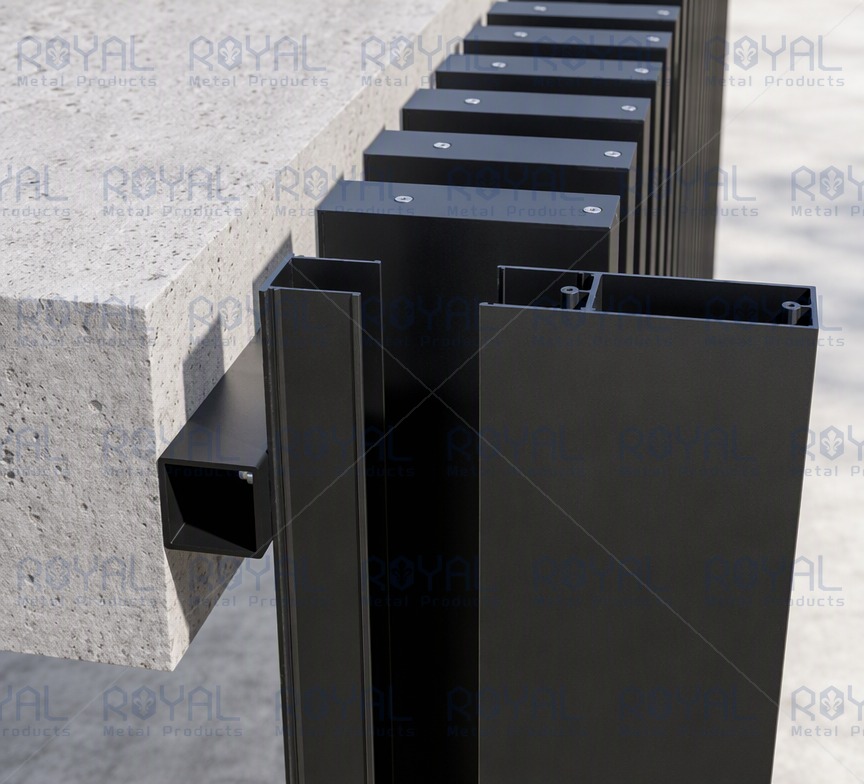
Figure 2: Two-piece snap-lock aluminum batten assembly detail: horizontal structural keel anchored to the concrete substrate, mounting the vertical base channel. The snap-on extruded batten (showing internal reinforcing web, screw flutes, and snap legs) locks seamlessly over the base without exposed surface fasteners, with top end-caps secured by twin fasteners.
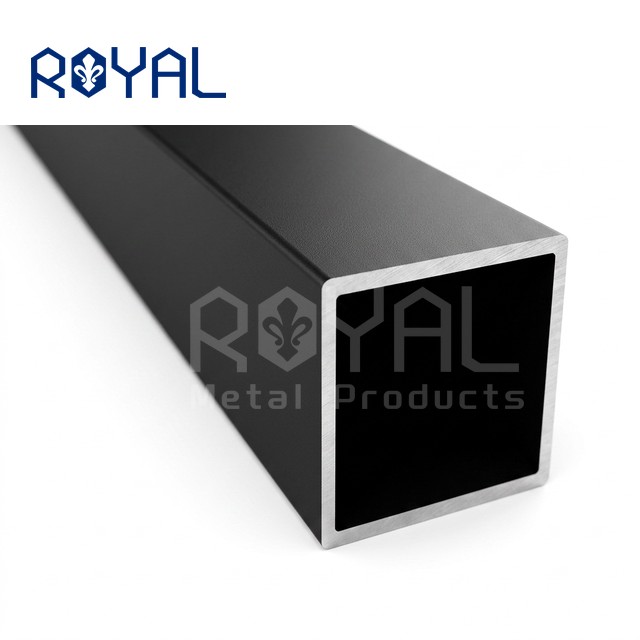
For modular framing, Royal Metal also supplies the matching Aluminum Slat Channel System and standard industrial Rectangular Tube Profiles, enabling buyers to consolidate complete facade packages under a single container order. For contractors evaluating material lifecycle economics, our technical comparison Aluminum Batten vs Timber: The 30-Year Cost, Fire & Supply Comparison provides the full mathematical model on total cost of ownership.
5. Sourcing Outlook (2026–2028): Where Commercial Facades Are Heading
Over the next 12 to 18 months, procurement executives should position their inventory around three clear trends:
Large-Span Tall Panels (Up to 4 Meters): Architectural elevations are ditching mid-span horizontal transoms. Single unbroken vertical battens reaching 3.5m to 4.0m are becoming the primary design language, requiring heavy-wall sections like 50×150 mm and 150×50×2.5 mm with engineered intermediate supports.
Dual-Finish Visual Rhythm: Project facades increasingly blend deep architectural satin black (RAL 9005 / Monument) with ultra-realistic sublimation woodgrain battens to create multi-dimensional residential and commercial facades.
Full System Sourcing: Top builders are consolidating purchases from extruders who can supply matching cast aluminum post caps, mounting brackets, keels, and perimeter Batten Screen packages under a single unified factory warranty.
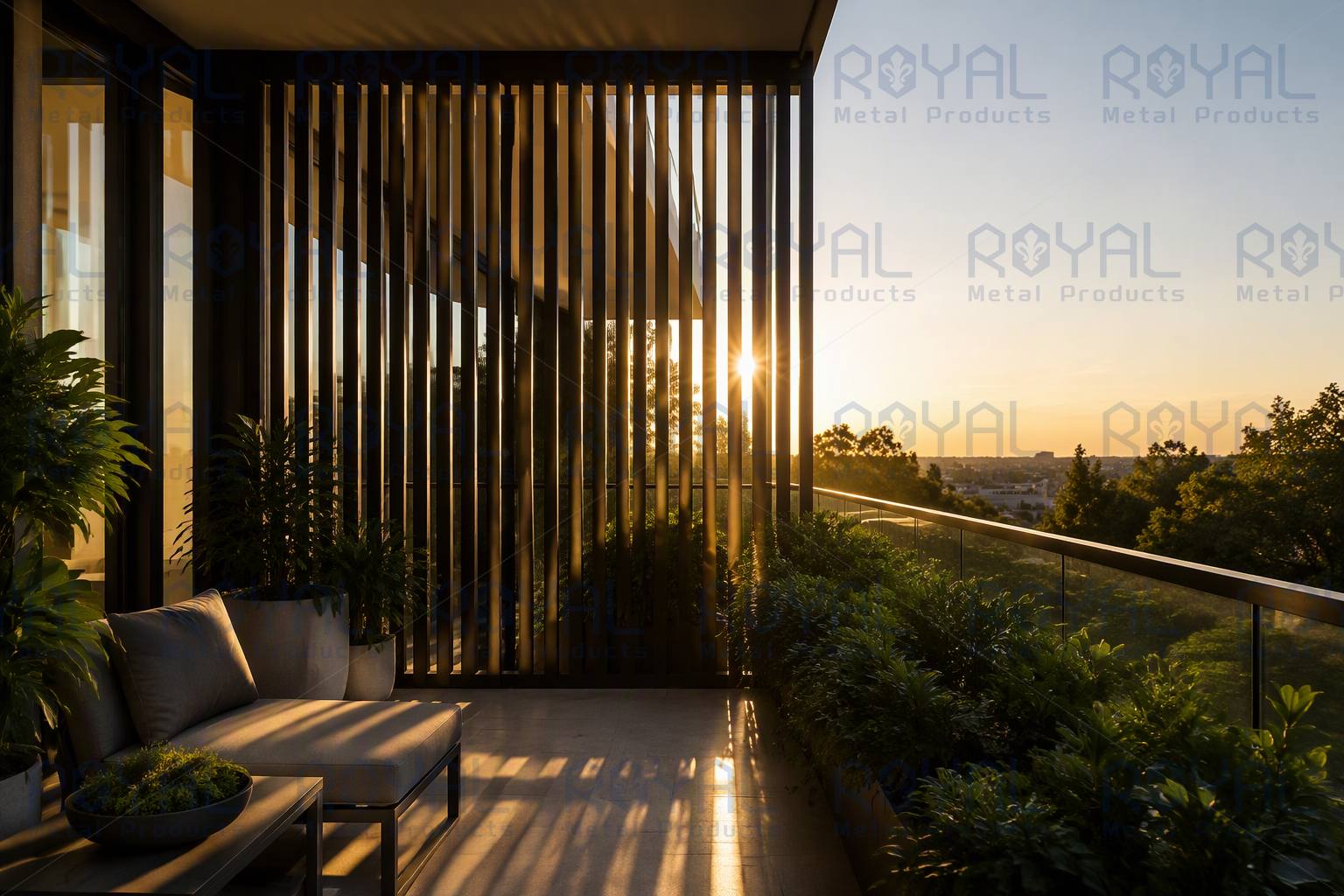
Figure 3: Contemporary residential balcony and terrace screening utilizing 50mm base vertical aluminum battens for 70% privacy and optimized airflow.
6. Procurement Readiness Checklist & Factory Contact
Before releasing tender packages or finalizing overseas procurement contracts, verify your supply partner against these operational requirements:
[ ] Size & Tooling Flexibility: Can the supplier provide comprehensive 30/50/75/100 mm base series up to 200 mm custom profiles with an accessible MOQ (500 kg for profiles ≤100 mm; 1 tonne for 100–200 mm)?
[ ] Structural Testing & Shop Drawings: Does the supplier provide detailed bracket connection drawings (e.g., RL-230 system), keel spacing guidelines (≤520 mm), and panel structural parameters up to 4,000 mm?
[ ] Duty-Free Manufacturing Hub: Can the supplier provide end-to-end local origin documentation (billet casting, extrusion, powder coating) from a duty-free location like Thailand to guarantee landed cost predictability?
Partner with Royal Metal for Your 2026 Facade & Screening Tenders
Royal Metal operates an integrated aluminum extrusion and deep-fabrication facility in Rayong, Thailand. We engineer and supply custom aluminum batten screens, privacy panels, architectural louvers, and structural profiles for distributors, builders, and OEM brands worldwide.
Manufacturing Hub: 246/3 Moo.10 Nong Lalok, Ban Khai, Rayong 21120, Thailand
Direct Technical Hotline: +66-61-320-0192 (English / Engineering Support)
WhatsApp Instant Consultation:Chat via +66-613200192
Tender & Quotation Inquiries:sales@royalaluminumtha.com / jenny@royaluminum.com
Request Profile Catalog, CAD Drawings & Factory Quote »
Get Inquiry


Recent News
1.Outdoor Privacy Screens Hit $3.16 Billion: Why Aluminum Batten Systems Are the 2026 B2B Choice
2026-08-062.Aluminum Batten vs Timber: The 30-Year Cost, Fire & Supply Comparison | Royal Metal
2026-08-143.UK Cladding Remediation Funding Now Open for Buildings Under 11 Metres: What It Means for Aluminum Facade Supply | Royal Metal
2026-08-204.Save on Aluminum Duties: Royalmetal Thailand Factory Advantage
2026-04-20