




Australia's Aluminium Slat Profile Supply in 2026: Why Origin Documentation Now Decides Your Landed Cost
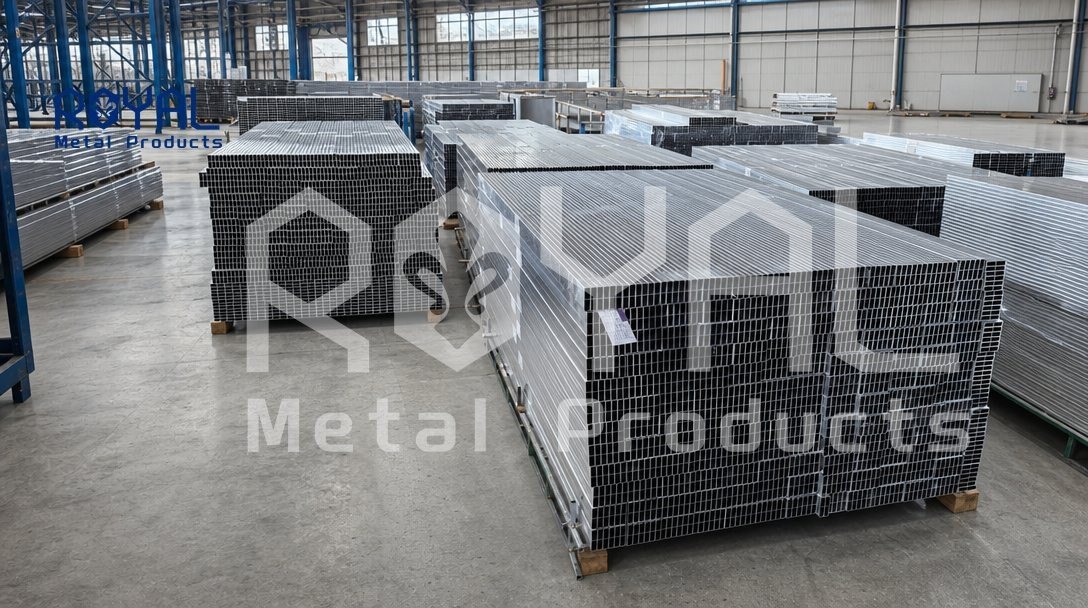
Australia's fencing market is valued at USD 0.94 billion in 2026 and is projected to reach USD 1.24 billion by 2031, a 5.70% CAGR (Mordor Intelligence). The global aluminium metal fencing segment is tracking from USD 4.93 billion in 2026 toward USD 6.35 billion by 2030 (Research and Markets). Inside those numbers, one product format is absorbing a disproportionate share of the growth: horizontal aluminium slat and batten systems.
Yet for Australian distributors, fabricators and project buyers, the variable that now moves margin further than any price negotiation is not the unit rate per kilogram. It is the country of origin printed on the mill certificate. The Anti-Dumping Commission's measures on aluminium extrusions have become sharply asymmetric by origin — and in 2026 that asymmetry, not the metal price, is what separates a predictable project from a repriced one.
Two structural shifts reshaping the category
The format has moved from picket to slat
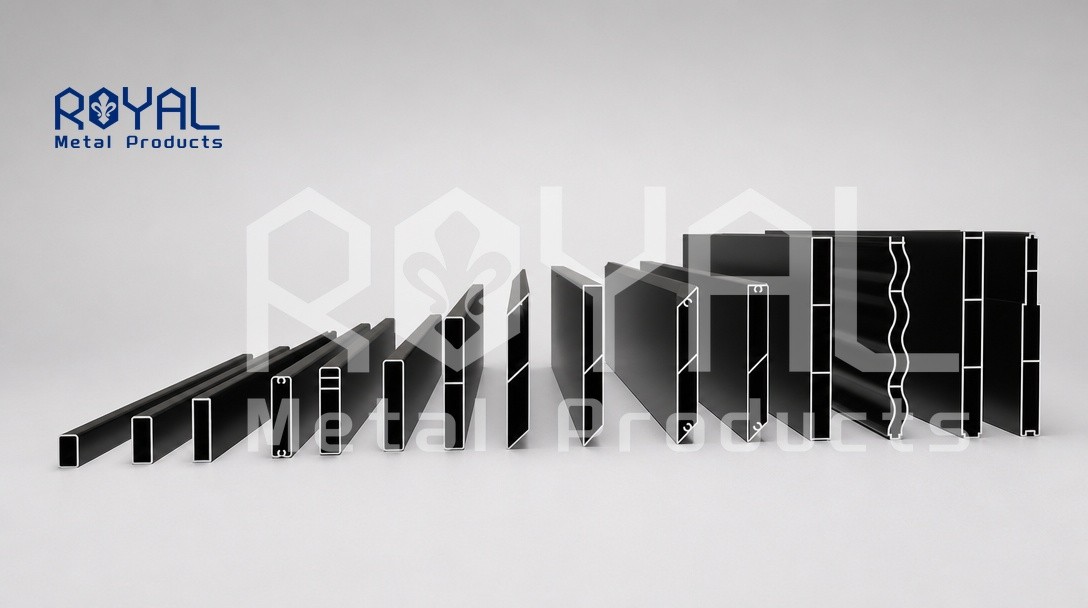
Slat and batten systems have become the default design language for Australian residential and commercial boundaries. The reason is functional before it is aesthetic. Slat spacing gives a continuously variable privacy gradient — a panel can be open at the top for airflow and closed at eye level for screening — which fixed picket and welded panel systems cannot deliver. The same profile set then carries across fencing, gates, screens, planters and enclosures, so a single extrusion line serves several product categories.
Sourcing has moved from finished panels to profiles
The second shift is on the procurement side. Australian fabricators are increasingly buying raw and semi-finished profiles and assembling locally rather than importing welded panels. Profiles nest tightly in a container, which lifts freight efficiency; they occupy less warehouse footprint than assembled panels; and cutting to the site's actual dimensions happens on the ground where the tolerances matter. The trade-off is that the buyer now owns the compliance question that the panel supplier used to absorb.
"The purchasing question in 2026 is no longer which supplier is cheapest per kilogram. It is whether the landed cost is still predictable twelve months from now."
The 2026 anti-dumping landscape: a country-by-country asymmetry
The Anti-Dumping Commission (ADC) maintains measures on aluminium extrusions that differ substantially by country of export. The current schedule, as published in the ADC's Dumping Commodity Register, reads as follows.
| Country of export | Measure in force | Imposed | Expires | Latest notice |
|---|---|---|---|---|
| China | IDD & ICD | 28 Oct 2010 | 28 Oct 2030 | ADN 2025/096 |
| Malaysia (mill finish) | IDD | 2 Jun 2021 | 2 Jun 2031 | ADN 2026/050 |
| Malaysia (surface finish) | IDD | 2 Jun 2021 | 2 Jun 2031 | ADN 2026/051 |
| Malaysia | IDD | 22 May 2026 | 22 May 2031 | ADRP Notice |
| Vietnam | IDD | 22 May 2026 | 22 May 2031 | ADRP Notice |
| Thailand | Not listed in the current Dumping Commodity Register | |||
Source: Australian Anti-Dumping Commission, Dumping Commodity Register — Aluminium Extrusions. IDD = Interim Dumping Duty, ICD = Interim Countervailing Duty. Confirm current status against the ADC register before committing to a purchase order.
First, the uncomfortable part: slat profiles are inside the scope
Any honest reading of the ADC's goods description has to start here. The measures cover aluminium extrusions of alloys in the 1, 2, 3, 5, 6 or 7 series, mill, mechanical, anodised or coated, with a wall thickness or diameter greater than 0.5 mm, a maximum weight of 27 kg per metre, and a cross-section that fits within a circle of 421 mm diameter.
A 65 mm × 16 mm horizontal slat with a 1.2 mm wall weighs 0.498 kg per metre. It fits inside that definition without argument. So does a 116 mm slat at 0.83 kg per metre. This is not a loophole category, and any supplier who tells you otherwise has not read the register. What varies between origins is not whether slat profiles are covered — it is which country's exporters carry the measure.
Second, the rate you see is not the rate you pay
Australia's interim dumping duty is not a flat percentage of invoice value. It has two components, and both are charged.
| Component | How it is calculated |
|---|---|
| Fixed | The higher of the actual dumping export price (DXP) and the ascertained export price (AEP), multiplied by the applicable duty rate |
| Variable | Where the DXP falls below the AEP, the shortfall is charged again in full |
A simple illustration of the mechanism: an invoice at AUD 1,000 against an ascertained export price of AUD 2,000 with a 10% rate produces AUD 200 in fixed duty plus AUD 1,000 in variable duty — AUD 1,200 against a goods value of AUD 1,000. The ADC's own register carries an explicit warning that the actual duty liability may exceed the published effective rate. Buyers who build their landed cost model from the headline percentage alone are modelling the wrong number.
Third, enforcement is moving up the value chain
The Commission's attention is no longer confined to profiles. A separate investigation into aluminium windows and doors exported from China (ADN 2026/017) has been running through 2026, and the Australian Glass and Window Association publicly reported that Chinese aluminium window imports rose approximately 30% following the initiation of that case. For anyone assembling slat systems in Australia from imported profiles, the pattern is worth noting: the further downstream the enforcement reaches, the more of the finished product sits inside the perimeter.
"Country of origin is not an exemption. Substantial transformation is."
What Australian buyers are actually losing sleep over
"The quote was firm for thirty days. The duty assessment was not." Because the variable component of interim dumping duty responds to the gap between invoice price and ascertained export price, a landed cost model built on the published rate can be wrong in either direction. A price concession negotiated with a supplier can, in the wrong origin, increase total duty rather than reduce it.
"We were told the origin was fine. Nobody asked how the metal got there." The Commission has a documented history of anti-circumvention action — including findings in 2015 and 2018 that extended measures to exporters in third countries. Origin is a documentation claim, not a shipping route. If the mill certificate cannot be reconciled to a melt-and-extrude sequence in the declared country, the origin is a liability rather than an asset.
"We carry eleven slat widths and four depths and we still miss orders." Slat systems multiply quickly: width, depth, wall thickness, finish, colour and cut length. SKU fragmentation ties up working capital and turns a warehouse into a museum of discontinued profiles.
"Our broker asked for the exporter's specification number and we did not have it." Australian import declarations for goods subject to measures require the dumping specification number (DSN), the country of origin, the tariff classification and the exporter's identity. For goods subject to the variable component, the importer must also substantiate a commercial relationship with the nominated exporter to obtain the confidential rates. That is a documentary obligation sitting with the buyer.
"The coastal project wanted a warranty we could not underwrite." Australian buyers increasingly specify material to AS/NZS 1866 and expect a coating warranty appropriate to a marine-influenced environment. A profile's corrosion performance comes from alloy, temper and finish system together — not from the width printed in the catalogue.
What forward-looking buyers are doing about it
Across the Australian distributors and fabricators who are holding margin through this cycle, three procurement moves recur.
| Dimension | China origin | Malaysia / Vietnam origin | Thailand origin |
|---|---|---|---|
| Measures in force | IDD & ICD through 2030 | Reinstated 22 May 2026, through 2031 | Not listed in the current register |
| Rate exposure | Effective rates for other exporters at 29.4% | Other exporters at 27.0% (MY) and 9.0% (VN) | Requires origin to be substantiated, not assumed |
| Declaration burden | High — DSN, rate enquiry, commercial history | High — mill and surface finish are separated | Process records and certificate of origin must reconcile |
| Buyer action | Re-price every order against current rates | Split mill and coated volumes in the cost model | Audit the manufacturing sequence before committing |
What to watch over the next 12 to 18 months
The duty assessment window on Chinese origin. Importation periods for the current Chinese measures run in six-month blocks, with applications for reassessment opening immediately after each period closes. Importers who believe they have overpaid have a defined route to recovery — and a defined deadline.
Judicial scrutiny of the Malaysian and Vietnamese measures. Both sets of measures have moved through the Anti-Dumping Review Panel, and earlier determinations in this commodity have been set aside on challenge. That volatility is itself a planning risk.
Whether enforcement extends to assembled systems. The windows and doors investigation is the clearest signal to date that the Commission will look at products that contain extrusions, not just extrusions themselves.
Any future anti-circumvention application touching Thailand. This is the tail risk that matters most to buyers who have moved volume to Thai origin. It is not a reason to avoid the origin; it is a reason to hold documentation that would survive a review.
Three questions worth asking before your next purchase order
Can your supplier produce a process record that reconciles the certificate of origin to a melt-and-extrude sequence in the declared country? If the answer is a shipping route rather than a manufacturing sequence, the origin will not hold under examination.
Does your landed cost model include the variable component of interim dumping duty? If it is built on the published effective rate alone, it understates exposure on exactly the orders where price competition forced the invoice down.
Can one channel system carry multiple slat widths? The most durable answer to SKU fragmentation is fewer profiles covering more applications.
A domestic manufacturer operating a full sequence — melting and casting, extrusion, anodising, powder coating and downstream fabrication in one facility — can document that chain. Royal Metal's Rayong facility in Thailand runs that sequence end to end, which is what allows a Thai certificate of origin to be supported by process records rather than by a bill of lading.
For Australian buyers building horizontal slat systems, the relevant profile range includes the 16mm depth slat profiles — thirteen models from 38 mm to 154 mm wide, 1.2 mm to 2.0 mm wall, 0.322 kg/m to 1.36 kg/m — and the 16 mm slat with an integrated screw channel, which removes the need for visible fasteners. These are paired with the aluminium slat channel system, where one channel profile across 30×30, 40×28, 48×28, 58×28 and 40×40 mm carries the full range of slat widths — the SKU consolidation point described above. For vertical applications, the vertical blade fencing system uses 65×16 and 50×10 blade profiles with matching caps, rails, brackets and posts.
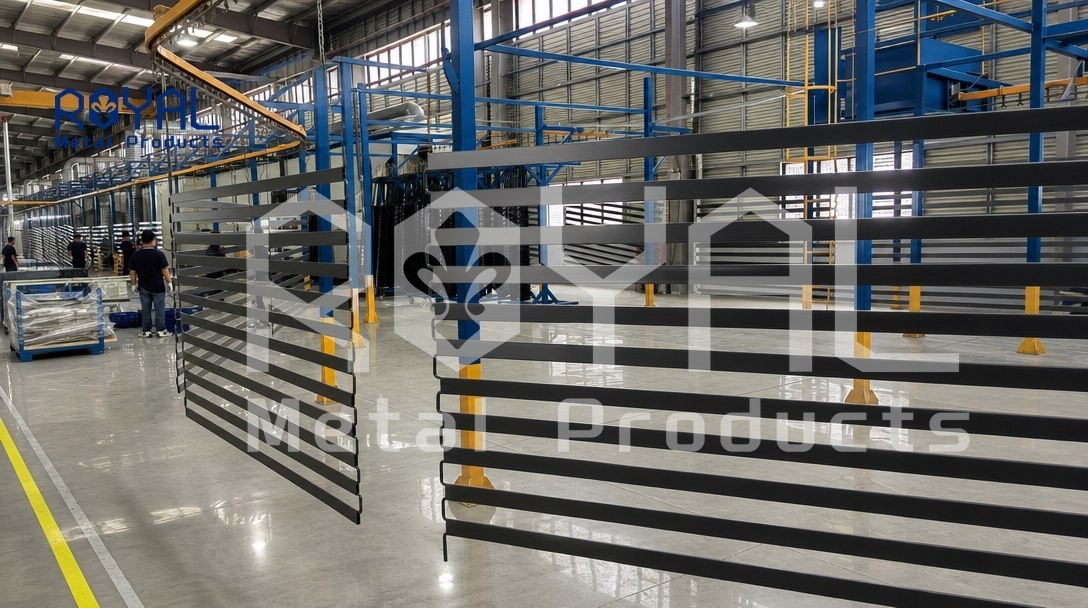
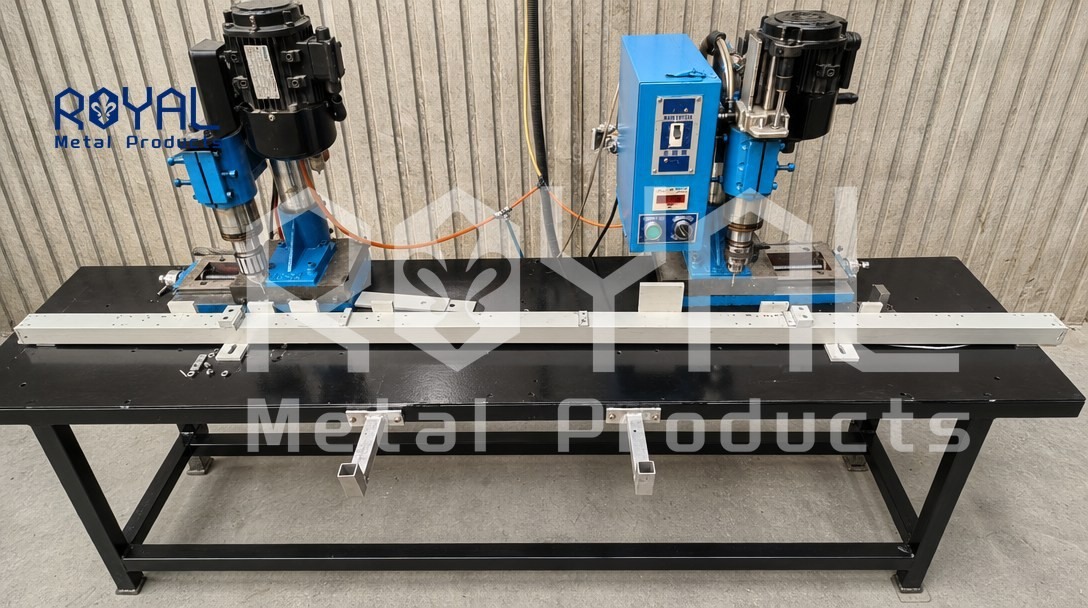
Profiles are supplied either as raw extrusion or with cut-to-length, pre-drilling, punching, pressed spear-top forming, end-cap matching and sequence-labelled packaging. Buyers who need assembled systems rather than profiles can review the aluminium finished products range, including batten screens and cladding panels.
Two related reads for buyers working through the compliance detail: our earlier analysis of NCC 2025 and AS 1926.1 requirements for Australian pool fencing, and the equivalent regulatory picture for EU-bound material under CBAM. The compliance logic differs by jurisdiction, but the operative question is the same in each: can the origin be documented, or only asserted?
Talk to us about your Australian project
If you are sourcing slat profiles for the Australian market, we can supply specifications against AS/NZS 1866, sample profiles for evaluation, and the origin documentation your broker will ask for.
Royal Metal Co., Ltd.
246/3 Moo.10 Nong lalok, Ban kai, Rayong 21120, Thailand
Tel: +66 61 320 0192
WhatsApp: +66 61 320 0192
Email: sales@royalaluminumtha.com | jenny@royaluminum.com
Anti-dumping measures and rates change. The figures cited here reflect the Australian Anti-Dumping Commission's published Dumping Commodity Register for aluminium extrusions and are provided for general guidance only. Importers should confirm current measures with the ADC or a licensed customs broker before committing to a purchase.
Get Inquiry
Recommended Products

Aluminum Slat Caps for Fence Panels & Privacy Screens — Complete Range, 8 Profiles

Aluminum Rectangular Tube Profiles | 6063-T5 Standard Mill Extrusion

16mm Aluminum Slat with Screw Hole – Modular System for Fence, Screen & Gate in Thailand

16mm Aluminum Slat Profile for Fence, Gate, Railing & Screen Systems

Aluminum Slat Channel System for Slat Fence, Gate & Enclosure Panels

Aluminum Slat Fence


Recent News
1.Aluminum Slat Profile: HSS vs Pocket – How to Choose the Right Slat for Fence & Screen Systems
2025-11-282.Why Aluminium Products Are Essential for Coastal Environments: A Smart & Long-Term Investment
2025-11-203.Industrial Aluminum Profiles That Power Innovation – Customized Solutions from Royal Metal
2025-04-234.Aluminum Pool Fence Requirements in Australia and the United States
2026-01-275.Aluminum Slat and Batten Fence Systems for Builders and Distributors
2026-05-296.C5-Ready Aluminum Fencing for Coastal Homes | Royal Aluminum
2026-05-147.Aluminum Pool Fence Australia: NCC 2025 Requirements, Fence Types & Design Guide
1970-01-01