





EU CBAM 2026 & Anti-Dumping Double Squeeze: Why Thailand-Origin Aluminum Is the Only Compliant Route
The European Union's aluminum import regime entered a new era in 2026 — and it is far more expensive than most procurement teams anticipated. On April 7, 2026, the European Commission published the first quarterly CBAM certificate price at €75.36 per tonne of CO₂ equivalent. Simultaneously, the EU launched an expiry review of anti-dumping duties on Chinese aluminum extrusions (up to 32.1%), a process that will keep the market in limbo through late 2027. For European distributors, façade contractors, and industrial buyers, the combined burden of carbon tariffs and anti-dumping margins now exceeds 35% on China-origin material. Royal Metal's Thailand facility — with documented lower carbon intensity and zero EU anti-dumping exposure — offers the only structurally compliant sourcing corridor into the Single Market.
1. CBAM 2026: The Carbon Bill Has Arrived
The EU's Carbon Border Adjustment Mechanism completed its transitional reporting phase on December 31, 2025. As of January 1, 2026, the financial phase is live: importers must purchase and surrender CBAM certificates corresponding to the embedded emissions of every ton of aluminum entering the EU.
1.1 The First Price: €75.36/tCO₂e
On April 7, 2026, the European Commission confirmed the Q1 2026 CBAM certificate price at €75.36 per metric ton of CO₂ equivalent, as reported by S&P Global. This is not a theoretical number — it is the actual settlement price EU importers are paying for Q1 2026 imports.
What this means for aluminum specifically:
Primary aluminum (global average): ~11.5 tCO₂e per ton → €866/ton CBAM cost at the Q1 rate
Chinese primary aluminum (coal-powered): ~16–20 tCO₂e/ton → €1,200–€1,500/ton CBAM cost
Extruded aluminum products: Even at 4–8 tCO₂e/ton for fabricated products, the CBAM cost ranges from €300 to €600 per ton on top of the base material price
1.2 The CBAM Phase-In Timeline
| Phase | Period | Obligation | Cost Impact |
|---|---|---|---|
| Transitional | Oct 2023 – Dec 2025 | Reporting only | €0 |
| Financial (Current) | Jan 2026 – Dec 2033 | Certificates required | €75+/tCO₂e |
| Full phase-in | 2034 onward | 100% certificate coverage | Full ETS price |

EU CBAM carbon certificate price Q1 2026 — €75.36/tCO₂e. Source: S&P Global / European Commission.
2. The Anti-Dumping Wildcard: Expiry Review AD664
While CBAM adds a carbon layer, the EU's long-standing anti-dumping duties on Chinese aluminum extrusions — ranging from 21.2% to 32.1% — remain in force. But for how long? That question is now formally under investigation.
2.1 AD664: The March 27, 2026 Trigger
On March 27, 2026, the European Commission published Notice C/2026/1920, initiating an expiry review of anti-dumping measures on aluminum extrusions originating in China (case AD664). The original duties were set to expire on March 31, 2026 — but the initiation of the review means they remain in effect throughout the investigation, which typically lasts 12–15 months.
2.2 Three Possible Outcomes — All Create Uncertainty
Extension: Duties continue at current rates (21.2%–32.1%) for another 5 years — the most likely outcome given the EU's historical pattern on Chinese aluminum.
Modification: Rates are adjusted based on updated injury and dumping margin analysis — unpredictable, but possible.
Termination: Duties lapse — unlikely given the political context, but even the possibility creates procurement paralysis.
The key point for EU buyers: you cannot plan a 2027 procurement strategy around Chinese aluminum when the duty rate could shift — or disappear — mid-contract. Thailand-origin extrusions, which are not subject to any EU anti-dumping measures, offer the only fixed-cost certainty in this environment.

EU AD664 expiry review — anti-dumping duties on Chinese aluminum extrusions under investigation through 2027.
3. Thailand: The Structural Compliance Advantage
The combined burden on China-origin aluminum extrusions entering the EU is now the sum of three cost layers:
| Cost Layer | China-Origin | Thailand-Origin (Royal Metal) |
|---|---|---|
| EU Anti-Dumping | 21.2%–32.1% | 0% |
| CBAM Carbon Cost* | €300–€600/t | €150–€300/t |
| Policy Uncertainty | High (AD664 review) | Low (stable regime) |
| Estimated Total Burden | 35%–55%+ | 3%–8% |
* Based on estimated embedded emissions for extruded aluminum products. Actual CBAM cost depends on billet source, energy mix, and verified emissions data. EU ETS free allowances phase down from 2026 through 2034, progressively increasing the effective CBAM rate.
Thailand's advantage is structural, not temporary. The country is not named in any EU anti-dumping measure on aluminum extrusions. And as Reccessary reported in January 2026, Thai CBAM-compliant exports to the EU surged nearly 55% in the months leading up to the financial phase — proof that the market is already voting with its supply chains.
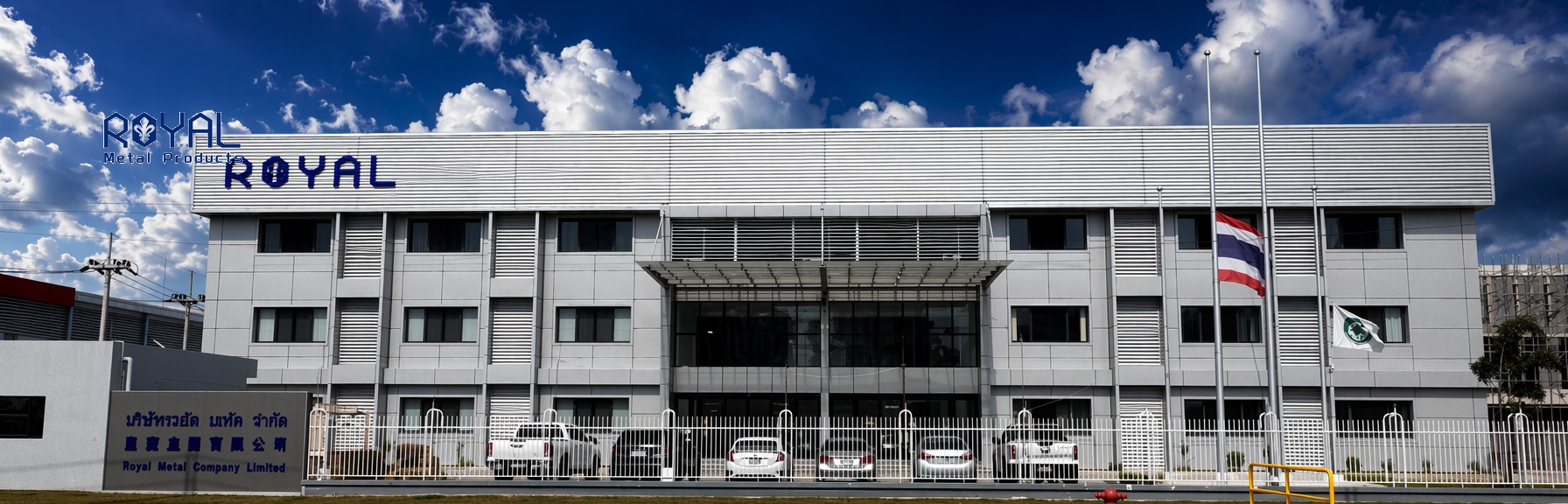
Royal Metal's Rayong, Thailand facility — BSCI-audited integrated manufacturing, AAMA-compliant finishing.
4. Royal Metal's Thailand Manufacturing: Evidence, Not Claims
CBAM compliance starts with documentation, not marketing. EU importers need verifiable production data, or they face default values that assume worst-case carbon intensity:
4.1 Lower Carbon Intensity by Design
Energy mix: Thailand's grid carbon intensity is 0.383 kgCO₂/kWh (CEIC, 2025), significantly lower than China's coal-dominated 0.609 kgCO₂/kWh (IEA, 2024). This directly reduces Scope 2 emissions on every extruded profile — a structural advantage under CBAM's embedded emissions methodology.
Vertical integration: In-house extrusion, fabrication, powder coating, and assembly under one roof means fewer intermediate transport emissions — a cleaner CBAM declaration with fewer upstream data gaps.
4.2 Export Documentation & Compliance Support
Based on Royal Metal's documented capabilities and audit trail, every shipment can be accompanied by:
Mill Test Certificates: Chemical composition and mechanical property reports per international standards for full material traceability
Certificate of Origin: Thailand preferential origin documentation, supporting your EU customs clearance
amfori BSCI Social Audit Report: Bureau Veritas-audited — available for download on our About Us page
CBAM emissions data support: We provide production energy data and material traceability records to assist your EU CBAM declarant in calculating verified embedded emissions
4.3 AAMA-Compliant Powder Coating
Royal Metal's in-house powder coating line meets AAMA 2604 / 2605 specifications — the North American architectural standard for 10–20 year warranty-grade aluminum finishing. For EU importers, this means profiles arrive pre-finished under a documented quality system, eliminating the cost and lead time of engaging a separate European coater. Combined with BSCI-audited manufacturing (Bureau Veritas), Royal Metal's Rayong facility provides the social and quality compliance documentation that EU procurement teams increasingly require.
5. The 2026–2027 Procurement Window: Act Now or Pay Later
The CBAM financial phase is not a one-time event — it's an escalating cost trajectory. As EU ETS free allowances phase down (from 2026 through 2034), the effective CBAM rate on aluminum will rise each year. Simultaneously, the AD664 expiry review will keep Chinese aluminum in a state of regulatory uncertainty through at least Q3 2027.
For a mid-sized EU aluminum distributor importing 500 tons of extrusions annually:
China-origin: €2,500/t base + 32.1% AD (€802.50) + CBAM (~€400/t) = €3,702.50/t landed
Thailand-origin (Royal Metal): €2,500/t base + 0% AD + reduced CBAM (~€200/t) = €2,700/t landed
On 500 tons, the annual delta is €501,250 — enough to fund an entire secondary processing line or a year of warehouse lease in Rotterdam.
6. Qualification Pathway for EU Importers
CBAM data request: Submit your product specifications and we return verified embedded emissions data for your specific profile, alloy, and finish — formatted for your EU CBAM declarant.
Sample with full documentation: Profile samples shipped with MTC, emissions report, and origin certificate — enough for your CBAM declarant and customs broker to pre-clear the import pathway.
Trial container: One 20' or 40' container of production profiles, processed through your normal EU port of entry, to validate clearance speed and documentation acceptance.
Framework agreement: 12–24 month supply agreement with quarterly price reviews tied to LME + billet premium — locking in the Thailand compliance advantage through the AD664 review period and beyond.
References
S&P Global, April 7, 2026 — Brussels confirms first CBAM certificate price for Q1 2026 at €75.36/tCO₂e
EU Tron Database, Case AD664 — Expiry Review: Aluminium Extrusions from China
Hong Kong TID, March 30, 2026 — EU Initiates Expiry Review of AD Measures on Aluminium Extrusions from Chinese Mainland
Reccessary, January 12, 2026 — Thailand's CBAM-compliant exports rise nearly 55%
EU Commission — Carbon Border Adjustment Mechanism
Explore Related Resources
Get Inquiry


Recent News
1.Why Modular Aluminum Fence and Gate Systems Are Gaining Momentum in the U.S. Market
2025-12-222.Precision Meets Performance – Royal Metal's Extruded Aluminum Profiles for Every Industry
2025-04-233.Why Aluminium Products Are Essential for Coastal Environments: A Smart & Long-Term Investment
2025-11-20