





Aluminum Batten vs Timber: The 30-Year Cost, Fire & Supply Comparison
The cheap fence is not the cheap fence. Timber screening costs $20–45 per linear foot installed — roughly half of an aluminum batten system. But lumber prices have climbed year-over-year for nine consecutive quarters, a well-maintained timber fence lasts 10–15 years against aluminum's 30+, and the $200-per-year stain-and-seal cycle quietly erases timber's upfront advantage. For distributors and contractors buying for the US, EU and Australia in 2026, the real question is not per-foot price — it is total cost of ownership, compliance risk, and whether your supply chain survives the next tariff cycle.
1. The Real Cost: Upfront Price vs. 30-Year Total Cost of Ownership
Installed timber fencing runs roughly $20–45 per linear foot; quality aluminum batten systems run $30–80 per linear foot. On the first invoice, timber wins. On the tenth year, the math flips.
Timber maintenance: staining, sealing and board replacement averages about $200 per year per project — and that assumes no rot, warp or termite damage.
Timber lifespan: a well-maintained wood fence typically delivers 10–15 years, after which replacement cost resets the whole calculation.
Aluminum lifespan: 30+ years with no painting, sealing or treatment program. The profile itself does not rot, warp or wick moisture.
Break-even point: industry analyses consistently show the cumulative cost of wood overtaking aluminum somewhere between year 10 and year 15 — before the timber fence is even replaced once.
For a 100-linear-foot run, that is roughly $2,000+ in maintenance alone over a single timber lifespan, then a full rebuild. An aluminum batten system installed once, at a known price, with predictable freight and tariff exposure, is the only number a CFO can actually budget against. For a complete product overview, see our aluminum batten screen systems.
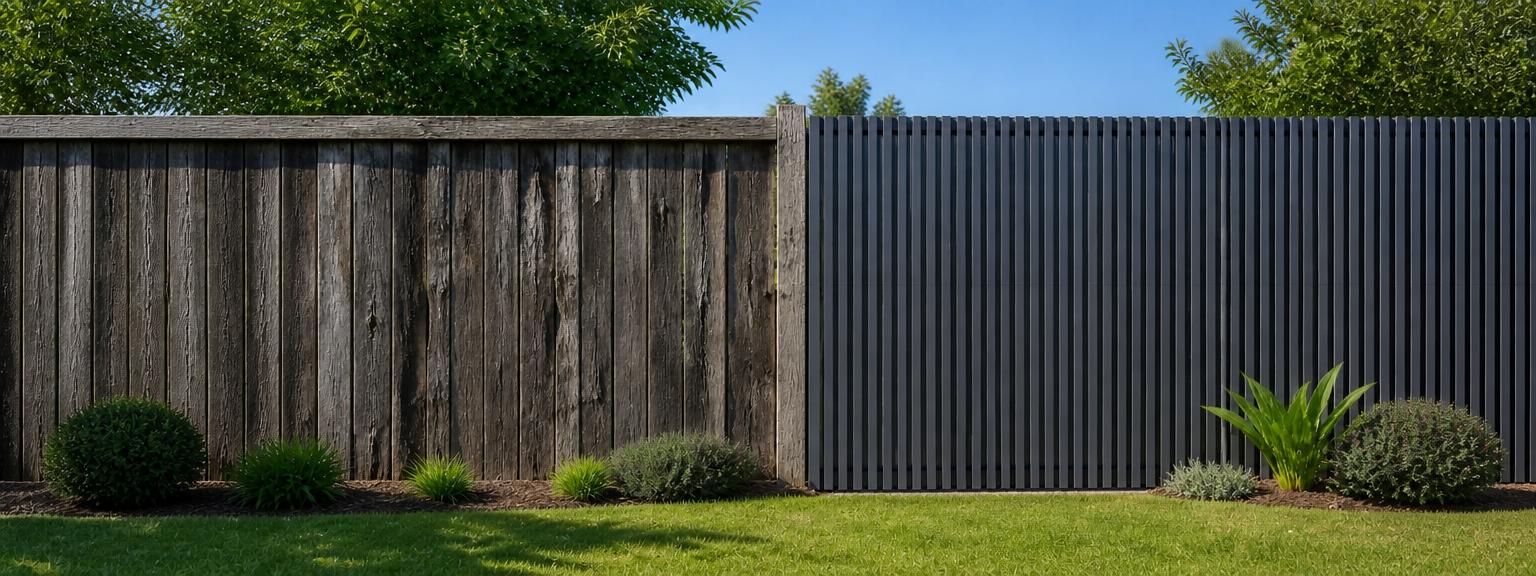
2. Durability & Finish: AAMA-Compliant Coatings vs. Weathering Wood
Timber is a natural material with natural failures: cupping, checking, grey oxidation, peeling stain and fastener corrosion where moisture sits. Aluminum battens fail on none of those vectors — provided the coating system is specified correctly.
That is where the coating standard matters. AAMA 2603/2604-compliant powder coating — the specification Royal Metal runs through its in-house QC lab in Thailand — is engineered for weather resistance and color retention on exterior architectural metal. Combined with an extruded 6063-T5 alloy core, it gives you:
Consistent geometry: every batten is the same straight, uniform section — no knots, no bowing, no board-to-board variation.
Color stability: the finish is baked on at the factory, not applied on site, so there is no annual re-coat cycle.
Design freedom: batten spacing, lengths and caps are cut to order, so screens, fences and gates share one visual language.
The aesthetic argument is not neutral either. The clean, slim shadow lines of a modern batten screen are the reason architects specify metal over timber in the first place — and that look is permanent, not "permanent until first repaint."
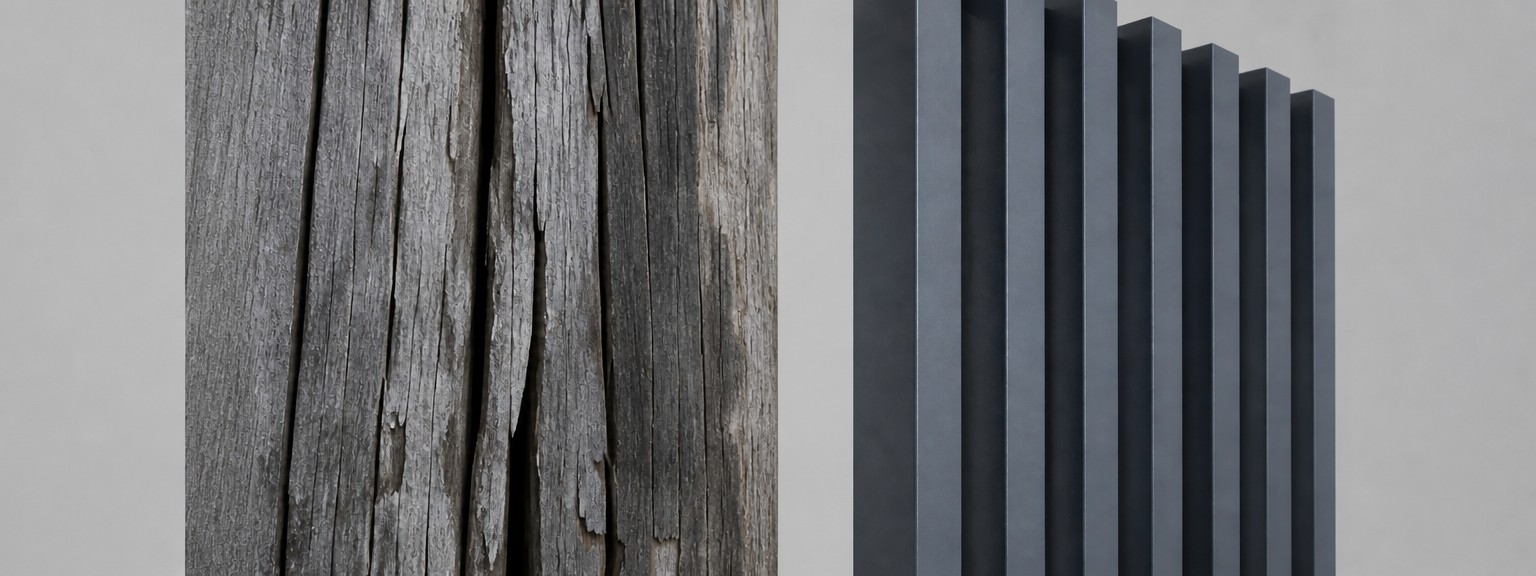
3. Fire, Termites & Wind: Why Compliance Is a Material Decision
In Australia, material choice is a regulatory decision as much as an aesthetic one. Bushfire-prone zones — BAL-12.5 through BAL-FZ under AS 3959 — push specifiers toward non-combustible construction, and timber screens are routinely the first component questioned in a BAL assessment. Aluminum is non-combustible and does not contribute to fire load, which is why it is the default answer in bushfire-rated screening, cladding and fence systems.
The same logic applies across the US wildfire belt, and in every region where termites and moisture are endemic:
Termites: timber fencing is food; aluminum is not. In termite-active markets — the US South, Australia, Southeast Asia — whole fence lines are replaced for reasons that never apply to metal.
Wind loading: extruded aluminum sections are engineered, not grown. Structural performance under AS/NZS 1170.2 wind loads is a matter of profile design and fixing specification, not luck of the grain.
Moisture & rot: ground contact is where timber dies first. Aluminum posts and battens have no moisture absorption path.
Note the standard itself: none of this requires a timber-style maintenance regime. The compliance story is documented at specification stage — and it stays true for 30 years. Still deciding between materials? Our 2026 aluminum fence buying guide walks through the full specification checklist.
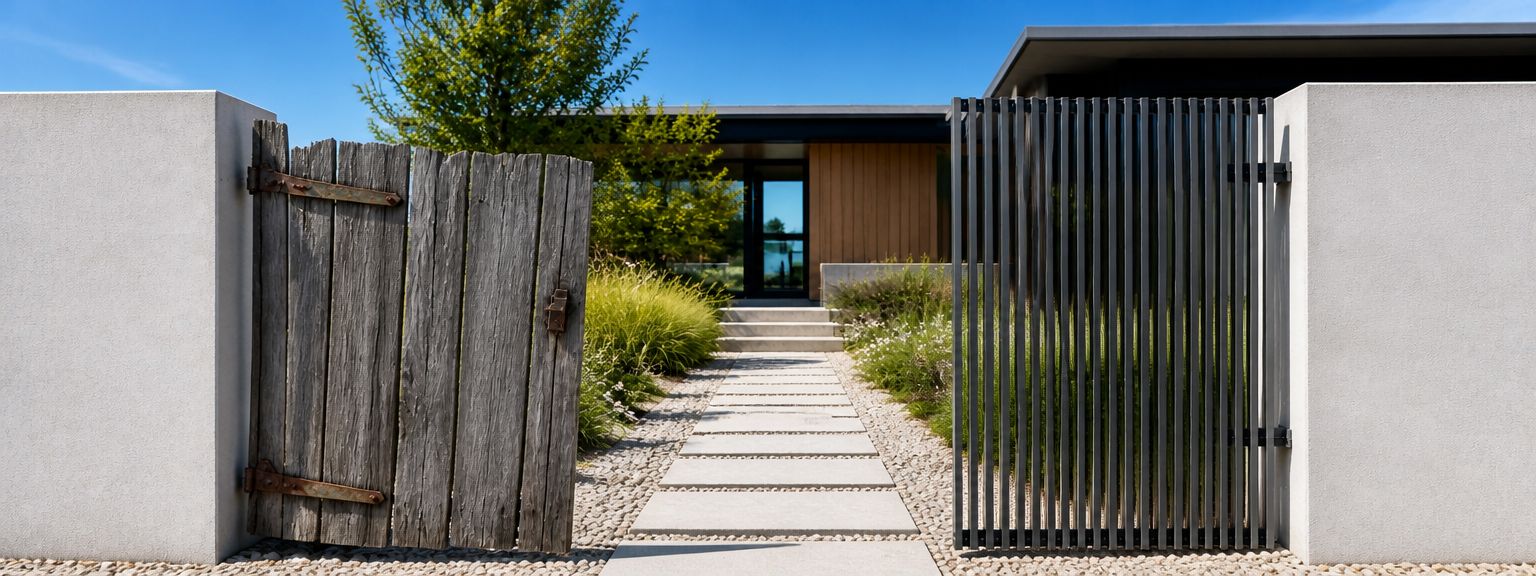
4. 2026 Supply Chains: Why "Cheaper Material" Is No Longer a Safe Bet
The quietest argument for aluminum battens in 2026 is neither cost nor durability — it is supply-chain predictability.
Timber has been a rolling cost crisis. Softwood lumber prices have risen year-over-year for nine consecutive quarters, driven by duties, demand and freight shocks, with forecasts showing further tariff-driven pressure through 2026. A material whose input price moves 8–10% in a quarter is a material you cannot quote twice.
Aluminum is exposed to a different variable — where it is made. The June 2026 White House proclamation on Section 232 tariffs extends additional duties of 10–50% on aluminum and steel derivatives — the category batten systems fall into — depending on the product and its country of origin. For US importers, origin is no longer a footnote; it is the line item that decides whether a project is viable.
This is precisely why Royal Metal manufactures in Thailand, not China. Our integrated factory — extrusion, CNC fabrication, powder coating, welding and assembly under one roof — ships Thailand-origin aluminum batten systems with the documentation chain buyers need: country-of-origin certificates, AAMA 2603/2604 coating records, and third-party audit reports (BSCI, SGS) behind every export. For buyers in the US, EU and Australia, that means a tariff exposure that can be modeled, quoted and held — instead of re-priced every quarter. For a deeper breakdown of duty exposure by market, see our Thailand strategic sourcing guide for 2026.
Combine the two trends and the strategic picture is clear: timber's input costs are volatile and rising; aluminum's costs are controllable at the origin — if you choose the origin correctly.
The Decision Framework
For distributors, contractors and DIY brands, the batten-vs-timber decision collapses into three questions:
Who maintains it for 30 years? If the answer is "the customer," aluminum's zero-maintenance profile wins on lifetime value.
What does your compliance officer say? In BAL-rated, termite-active or wind-exposed markets, non-combustible engineered aluminum removes an entire class of specification risk.
Can you quote it twice? If timber's input price moves 8–10% per quarter, you cannot. Thailand-origin aluminum from an integrated factory gives you a price you can hold.
Royal Metal builds aluminum batten and slat systems — from privacy slat fences to vertical blade fencing and 16mm slat profiles — engineered for 30-year service and shipped with a verifiable Thailand-origin document chain. Send us your drawings and get a quote you can actually hold to.


